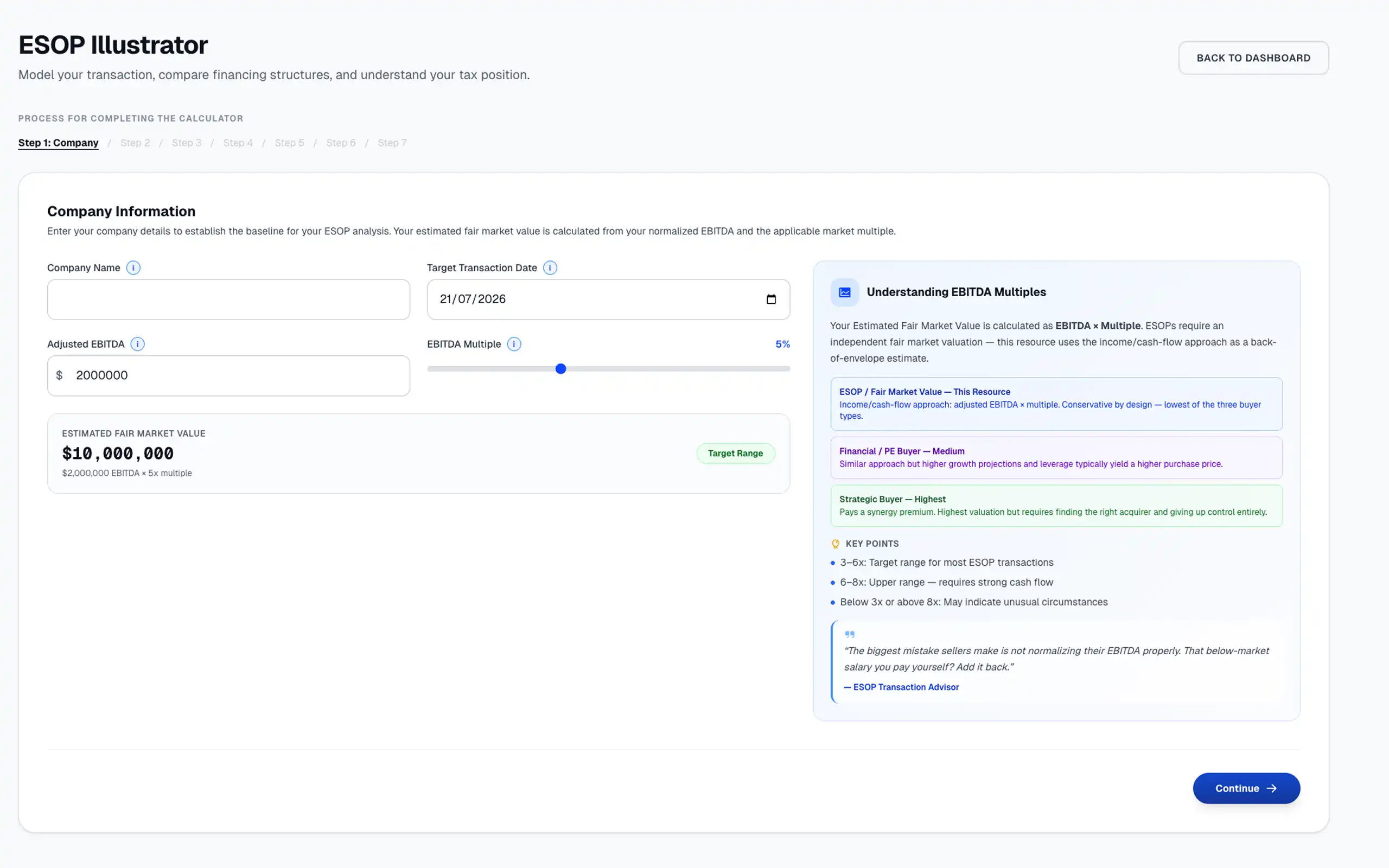
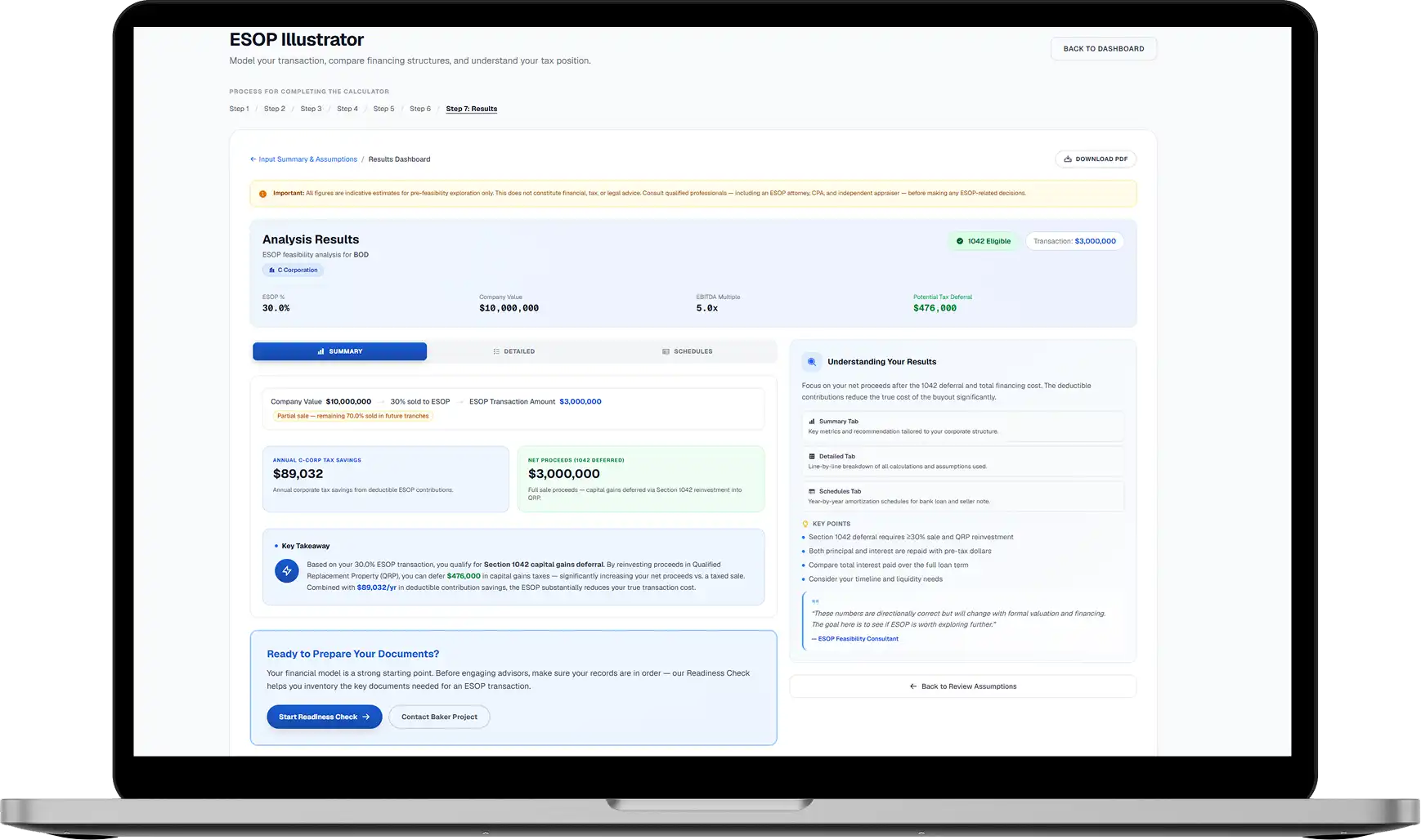
ESOP Illustrator
Interactive calculator modeling valuation, financing, tax impact, and deal structure.
Exports a full PDF feasibility report with real-time scenario testing.
Making employee ownership succession accessible, understandable, and actionable for every business owner
The Pennsylvania Center for Employee Ownership (PaCEO)
ESOP Education & Pre-Feasibility SaaS Platform
Business Succession Planning / Employee Ownership
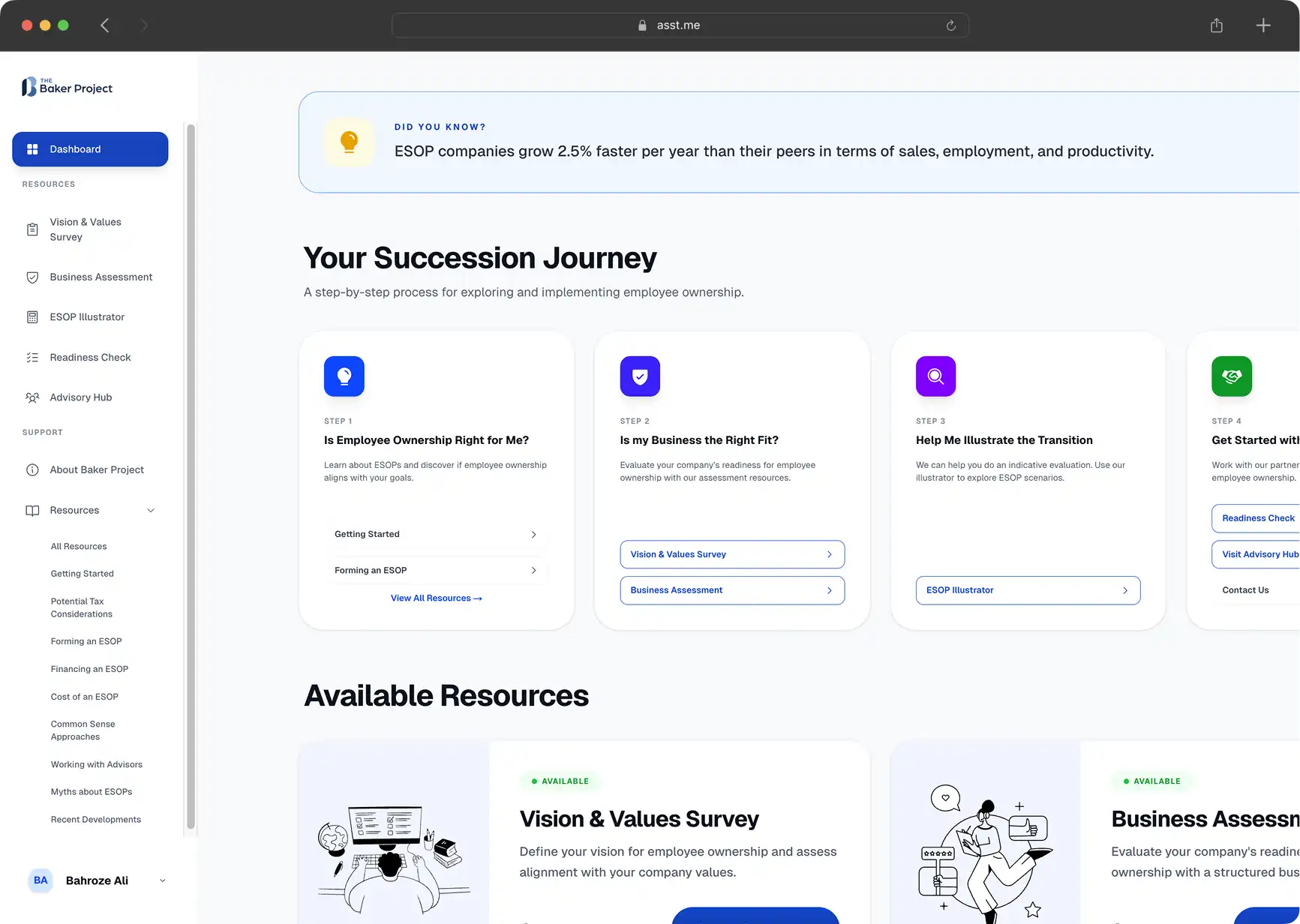
The Pennsylvania Center for Employee Ownership (PaCEO) is a registered 501(c)(3) non-profit on a mission to advance employee ownership as a succession strategy for businesses across the country. Through their Baker Project initiative - made possible by a founding endowment from Ken Baker, former CEO of NewAge Industries and an employee-owner himself - PaCEO set out to build a free, accessible platform that could educate business owners about employee ownership and give them the tools to explore it on their own terms.
The need was clear. An estimated 80% of U.S. business owners have no succession plan, and the majority of those who do exit - selling to private equity or strategic buyers - report deep regret within a year. Employee ownership offers a fundamentally different path, one where owners can exit at fair market value while preserving the company culture and ensuring the people who helped build the business share in its future. Yet most of the resources available were locked behind paywalls, written for financial professionals, or produced numbers without any of the context needed to understand them.
PaCEO approached us to change that. The goal was to build a modern, guided platform that could take a business owner from initial curiosity - does this even apply to me? - all the way through financial modeling, readiness assessment, and advisor connection. No cost to the user. No prior knowledge required. And no pressure to disclose anything before they were ready.
The resources that exist around ESOP succession planning are largely inaccessible to the people who need them most. Industry organizations like the National Center for Employee Ownership (NCEO) have done meaningful work, but their tools - including a foundational pre-feasibility calculator - were built for a different era. Static, clinical, and stripped of any educational context, they produced numbers without meaning.
A business owner who didn't already understand ESOP financing structures, seller notes, mezzanine debt, or Section 1042 tax deferral would leave more confused than when they arrived. The deeper resources - the guides, the advisory relationships, the financial modeling - sat behind paywalls, consulting retainers, and hours of back-and-forth with specialists whose fees alone could discourage early exploration.
There was no trusted, neutral starting point. No way for a business owner to privately ask: does this even make sense for me? PaCEO had been fielding these questions through consultations and community events - but demand was outpacing what a human-led approach alone could serve.
The challenge we took on was significant: translate a complex, high-stakes financial and legal process into an experience that felt approachable, trustworthy, and useful from the very first interaction - even for a business owner who had never heard the acronym ESOP before opening the page.
We opened with a discovery phase that went beyond wireframes and feature lists. Before writing a line of code, we needed to understand the emotional terrain of the user: a business owner in their 50s or 60s, who has spent decades building something, and is now facing one of the most consequential decisions of their professional life.
What we heard, consistently, was a combination of curiosity and anxiety. These owners weren't opposed to employee ownership - many were genuinely moved by the idea. What stopped them was the friction of getting real information. The first advisor conversation required disclosing financial details they weren't comfortable sharing yet. The first calculator produced a number they didn't know how to interpret.
From that understanding, we built our product strategy around three commitments:
The platform would never produce outputs without context. Every tool explains what it measures, why it matters, and what the result means for the owner - like a conversation with a knowledgeable friend, not a software form.
A business owner exploring succession isn't ready to go public with that fact. All financial modeling runs entirely in the browser - no sensitive numbers ever leave the user's device until they choose to share them.
Some start by asking about tax implications, others by wondering if their values align with shared ownership. Each tool serves as an independent entry point, valuable on its own, while building toward a complete picture.
With that strategy in place, we designed a monorepo architecture - two distinct applications sharing a single codebase - that allowed us to serve both anonymous explorers and committed users without compromising the experience for either. The public survey site required no account; the authenticated dashboard offered depth, saved sessions, and a guided succession journey for owners ready to go further.
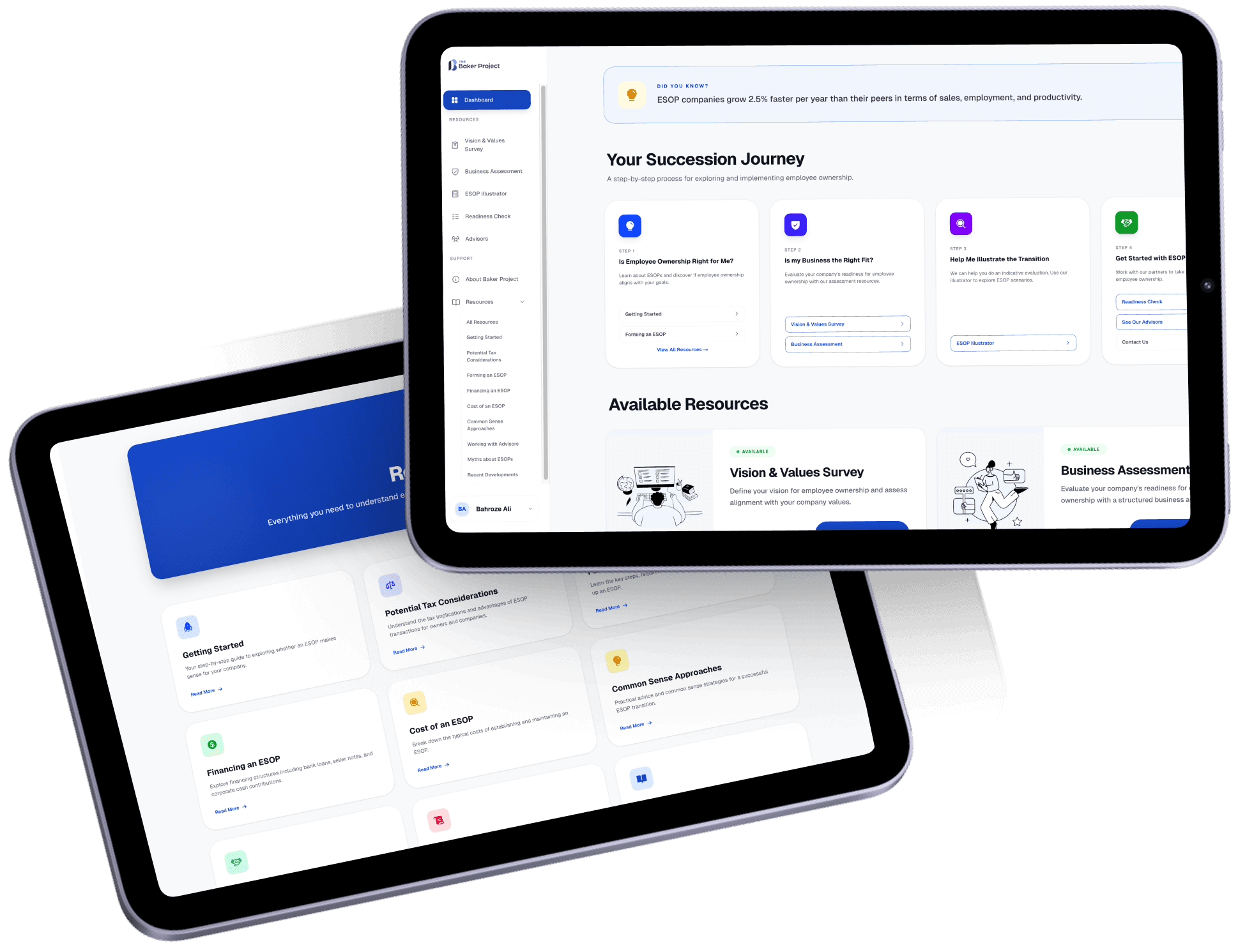
The platform launched at bakerproject.org and app.bakerproject.org as a suite of interconnected tools, each addressing a distinct phase of the ESOP exploration journey.
Interactive calculator modeling valuation, financing, tax impact, and deal structure.
Exports a full PDF feasibility report with real-time scenario testing.

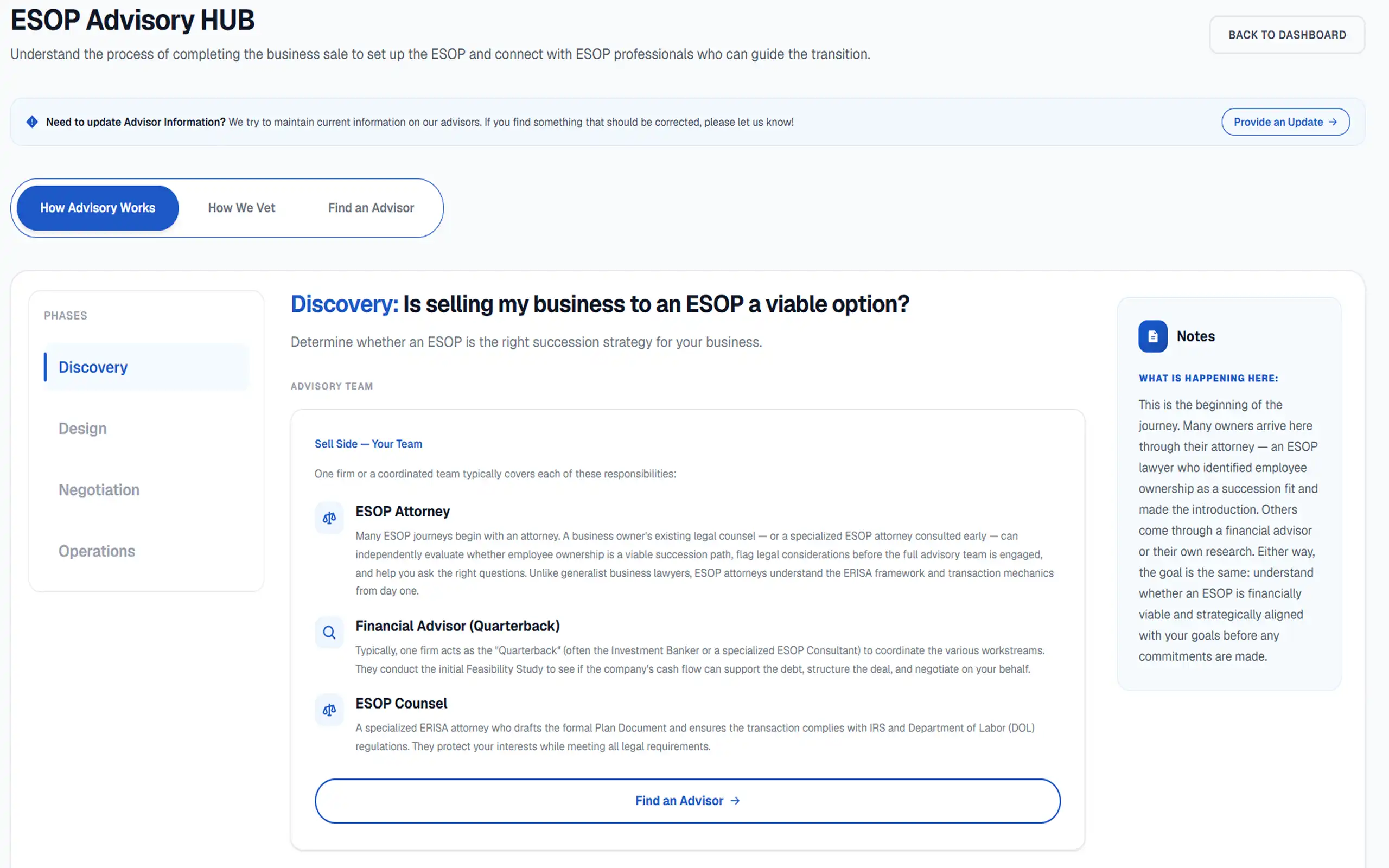
Connects owners with trusted ESOP professionals and specialists.
Find attorneys, lenders, valuation experts, trustees, and advisors.

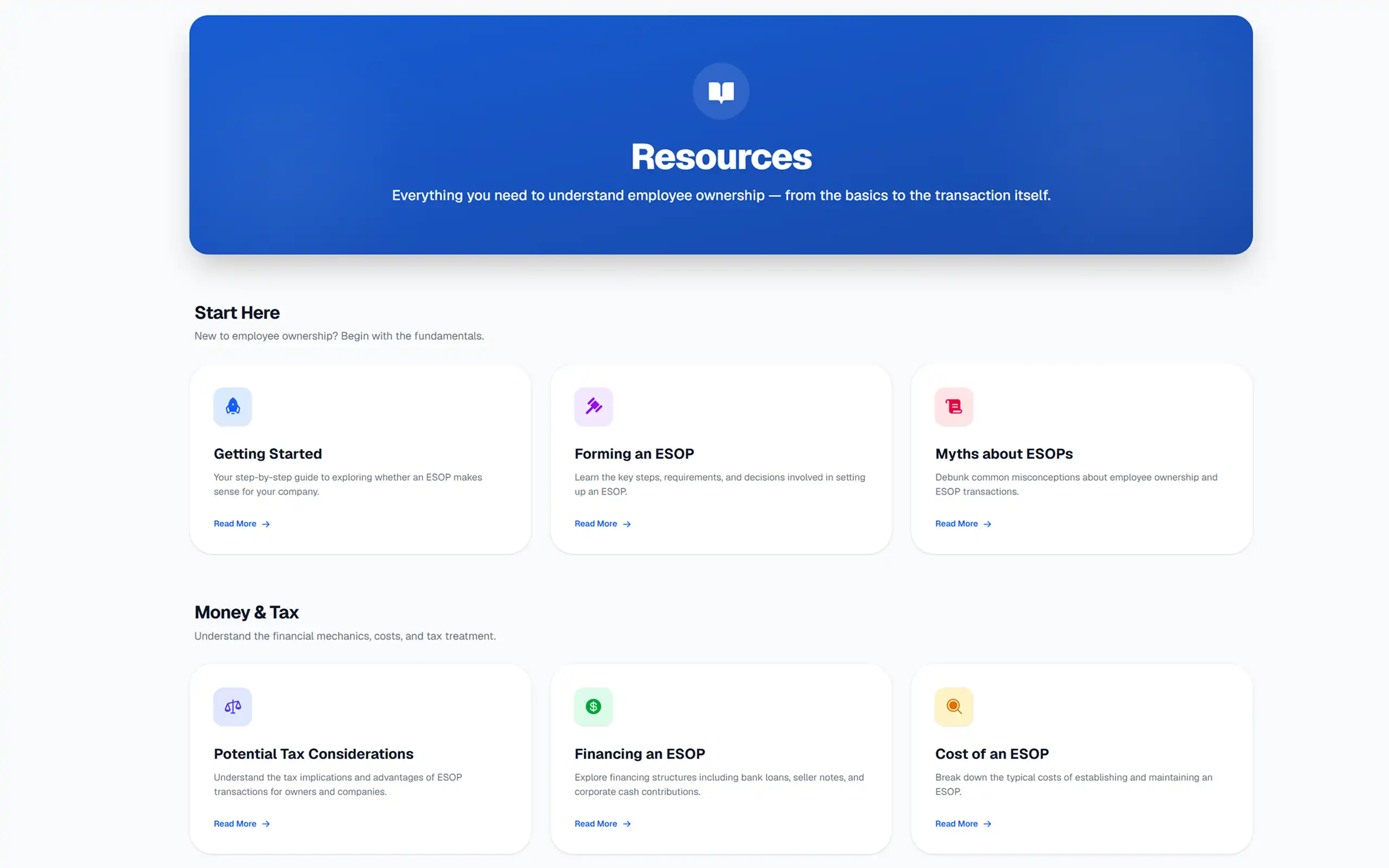
Nine curated sections covering the full landscape of ESOP knowledge.
Plain-language and free, replacing paywalled, outdated alternatives.
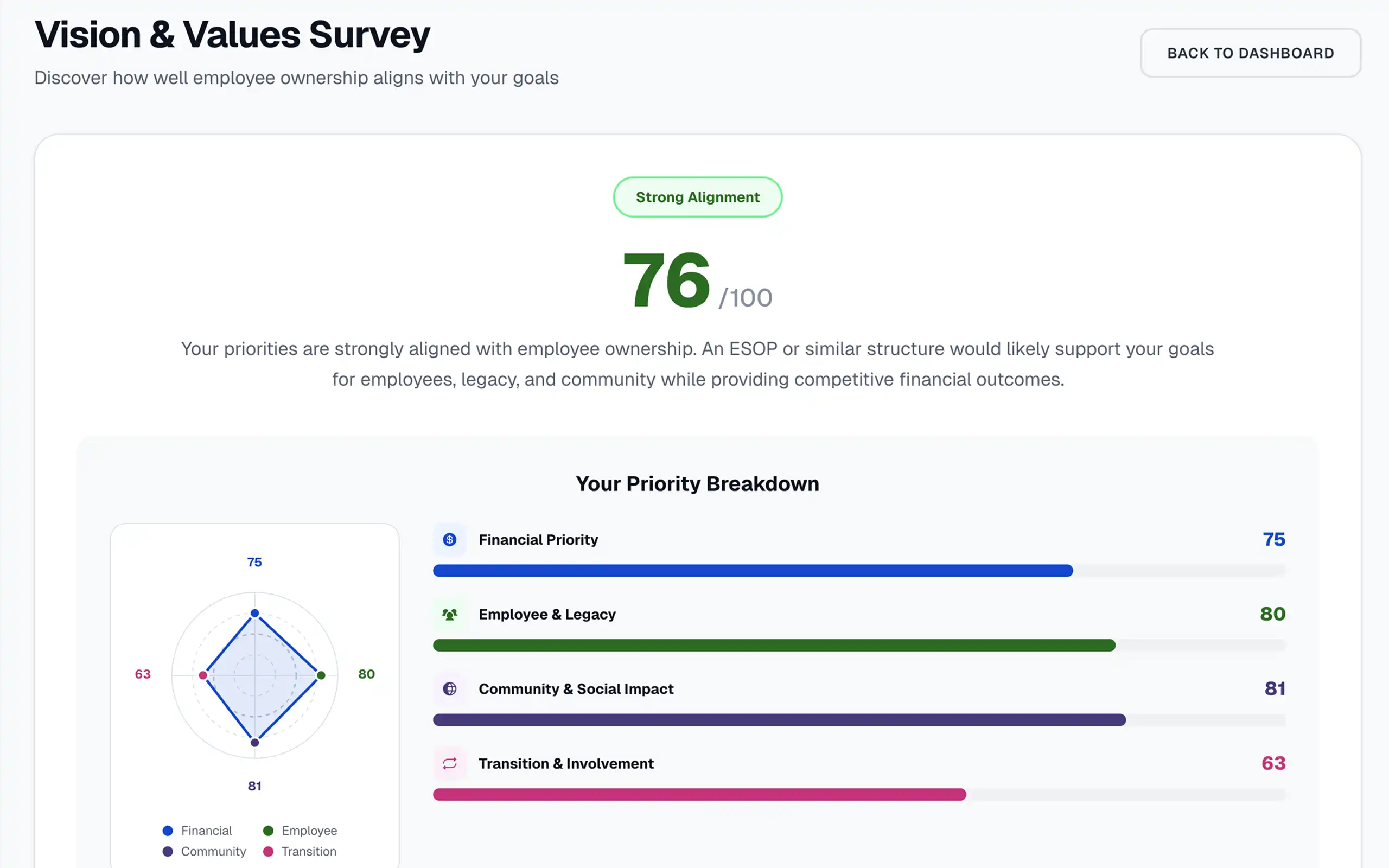
7-step survey helping owners see if employee ownership aligns with their values.
Generates an alignment score and radar chart across four key dimensions.
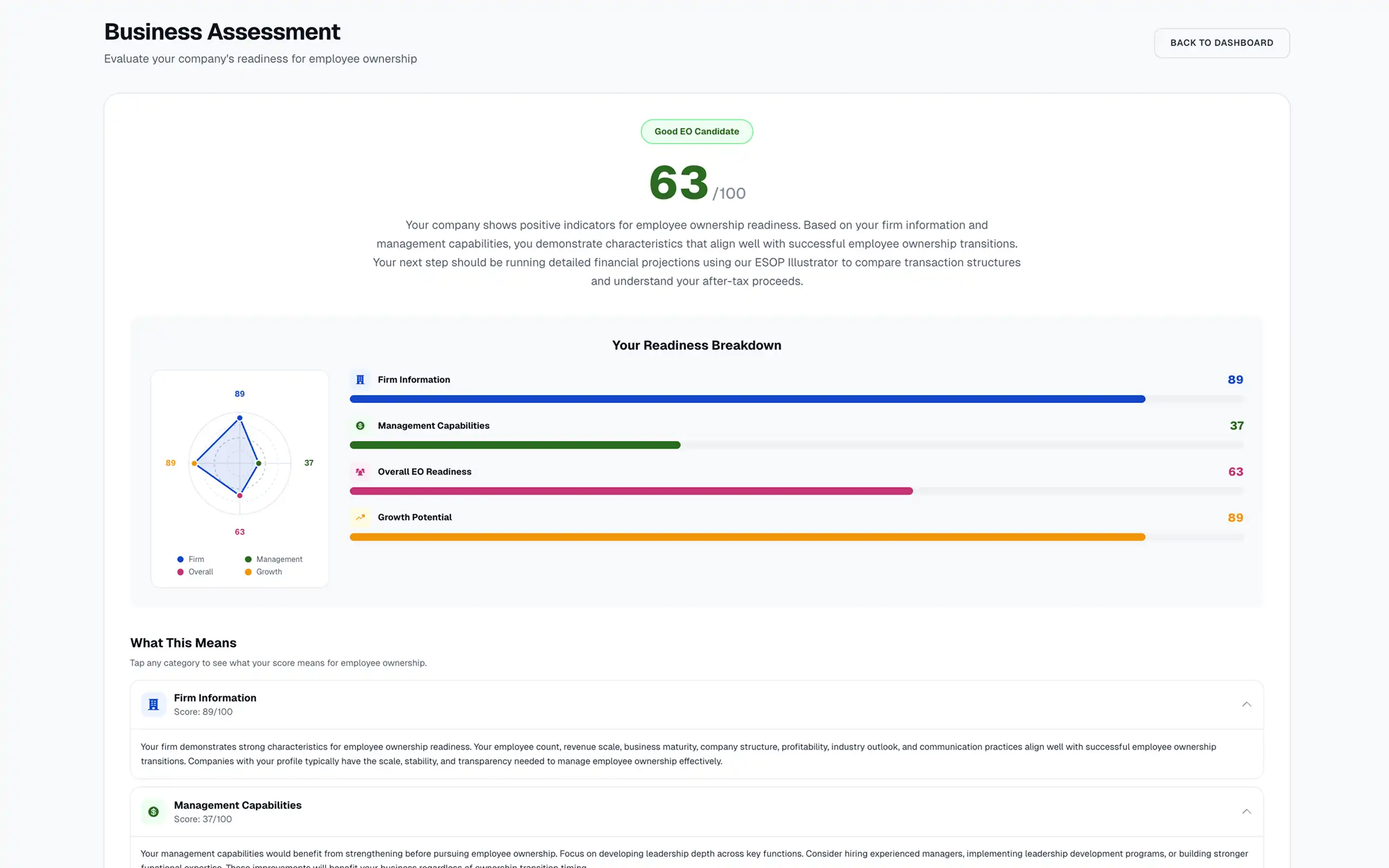
Evaluates if the company is a strong ESOP candidate across five readiness areas.
Provides scores, radar charts, and practical guidance for improvement.
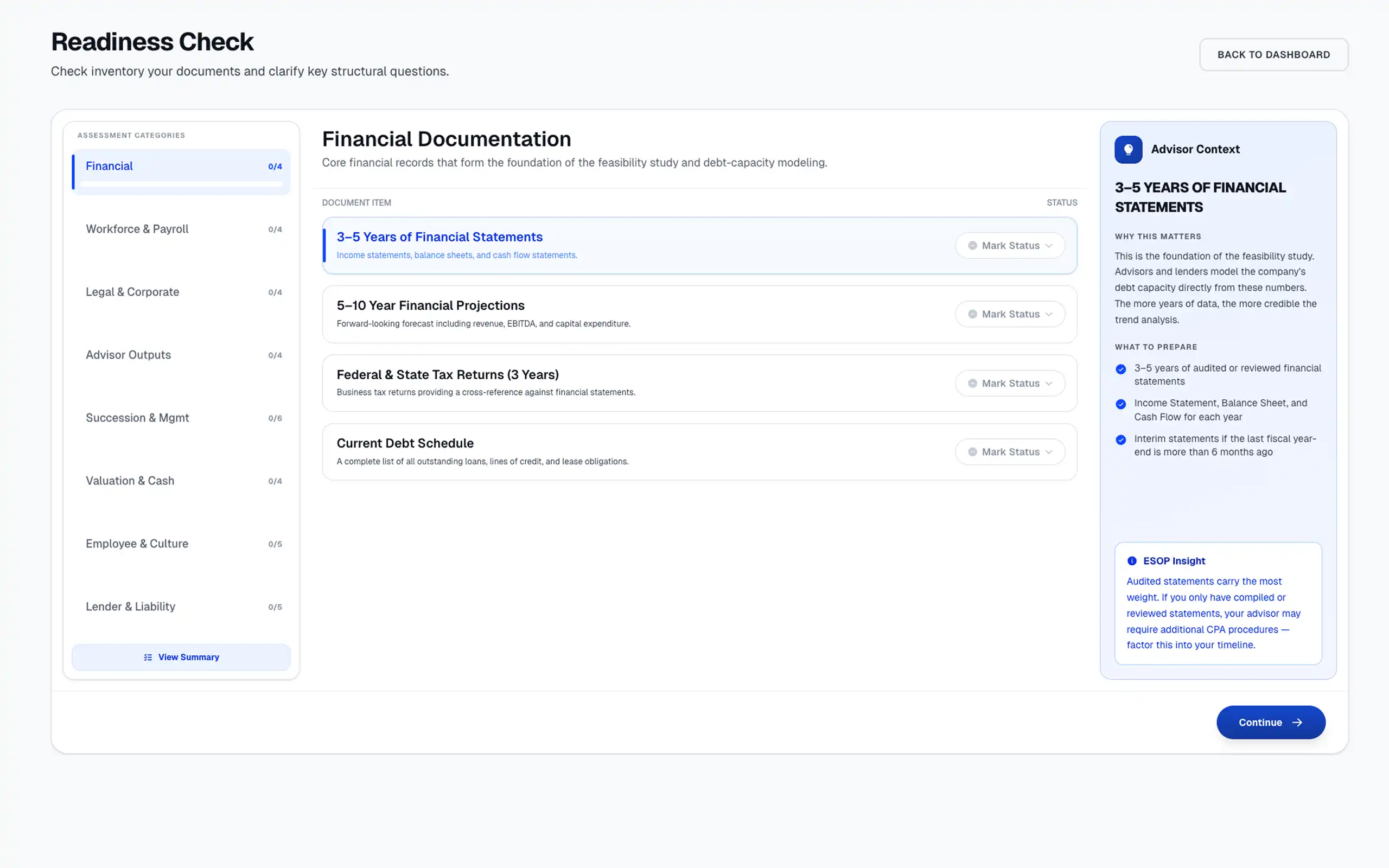
Checklist to organize financial, legal, and operational documents early.
Tracks progress with Ready, In Progress, and Not Sure statuses.
A quick call to see whether Discovery is the right next step for your idea.
Knowing what problems exist ≠ knowing what to build
Knowing what to build ≠ knowing what to build first
Your insights are valuable. Discovery makes sure they turn into the right Product.
That's exactly how we designed this.
After Discovery, you get:
You own what we produce, and the blueprint works for any capable team. If you want us to build it, great. If not, we've set you up to succeed with whoever does.
No. Product Discovery is just as useful for a Product that's scaling or pivoting: markets shift, and assumptions expire faster than Founders expect.
You get answers across the 4 phases of Discovery:
You walk away knowing what to build, what not to build, and why, with a plan any team can execute.
Know If Product Discovery Is Right for You
The platform is live and active at bakerproject.org and app.bakerproject.org, serving business owners across the country who previously had no accessible, trustworthy starting point for ESOP exploration.
What has shifted most visibly is the nature of the first conversation. Business owners now arrive at their first advisory interaction having already modeled their transaction, assessed their readiness, and identified gaps in their documentation. The hours of back-and-forth that once characterized early ESOP exploration have been compressed into a self-directed session on a Tuesday evening - before anyone else knew they were thinking about it.
The public survey tools serve as a frictionless discovery layer, allowing owners who aren’t yet ready to create an account to explore alignment privately, with conversion into the authenticated platform happening organically. The ecosystem of partner advisors - spanning major institutions including Citizens Bank, M&T Bank, and BNY Mellon, alongside law firms, valuation specialists, and wealth managers - now has a modern digital front door that educates prospective clients before they ever schedule a call.
The platform continues to grow. Capital structure modeling, a full EO model comparison tool (ESOP vs. Employee Ownership Trust vs. Worker Cooperative), personal wealth planning with 1042 strategies, and a transaction timeline planner are in active development - each adding another layer to what is becoming the most comprehensive free resource for ESOP pre-feasibility in the country.
There is a generation of business owners approaching the most consequential transition of their professional lives without adequate information, accessible tools, or a trusted place to start. The ESOP model - one that rewards the people who helped build the business and preserves what the owner worked decades to create - remains underutilized not because it doesn’t work, but because getting to a real answer has always required too much: too much disclosure, too much expense, too much time navigating a system designed for specialists.
This project was about removing those barriers, one at a time. By building a platform where a business owner can move from initial curiosity to a fully modeled transaction - understanding the financial structure, assessing readiness, identifying documentation gaps, and finding the right professional to help them close - we turned a process that once took months of expensive back-and-forth into something a single person can begin on their own terms, at their own pace, for free.
At Biz of Dev, we believe the best products don’t just solve a problem - they change who gets access to the solution. This engagement was a clear example of that: technology not as a product in itself, but as the infrastructure for a more informed, more equitable path to one of the most important decisions a business owner will ever make.